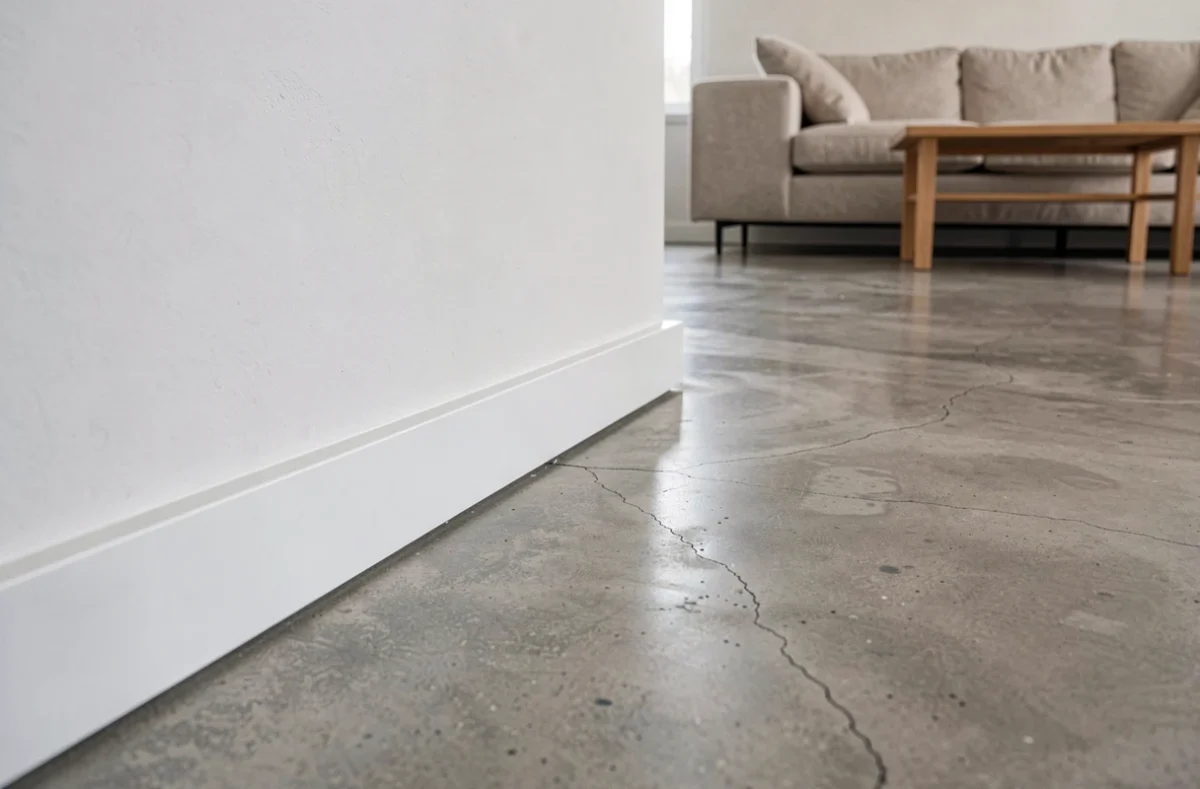
Polished concrete appeals with its continuous surface, without visible joints, creating an impression of raw and controlled space. The baseboard, however, interrupts this continuity. If poorly chosen, it creates a visual break or, worse, blocks a structural movement of the floor and causes cracks within a few months. Therefore, the choice of a baseboard for a polished concrete floor is as much about technique as it is about aesthetics.
Perimeter joint and baseboard: the technical point that no one details
Polished concrete is a thin micro-coating, usually applied in layers of one to a few millimeters. This thinness makes it sensitive to movements of the substrate. At the junction between the wall and the floor, a flexible perimeter joint must remain functional to absorb the expansions and contractions of the flooring system.
A rigid baseboard screwed or glued to both the wall and the floor eliminates this movement allowance. The result is predictable: micro-cracks at the foot of the wall, water infiltration in humid rooms, localized detachment of the covering. The basic rule is simple: the baseboard is fixed to the wall, never to the floor.
This principle applies to all types of baseboards, but it becomes critical with polished concrete because the covering does not compensate for the mechanical stresses of the substrate. Existing expansion joints in the slab should never be rigidly covered. A detailed guide on the subject of polished concrete baseboards on Miss Déco also reminds us of the thicknesses to be respected according to uses, from decorative walls to kitchen floors.
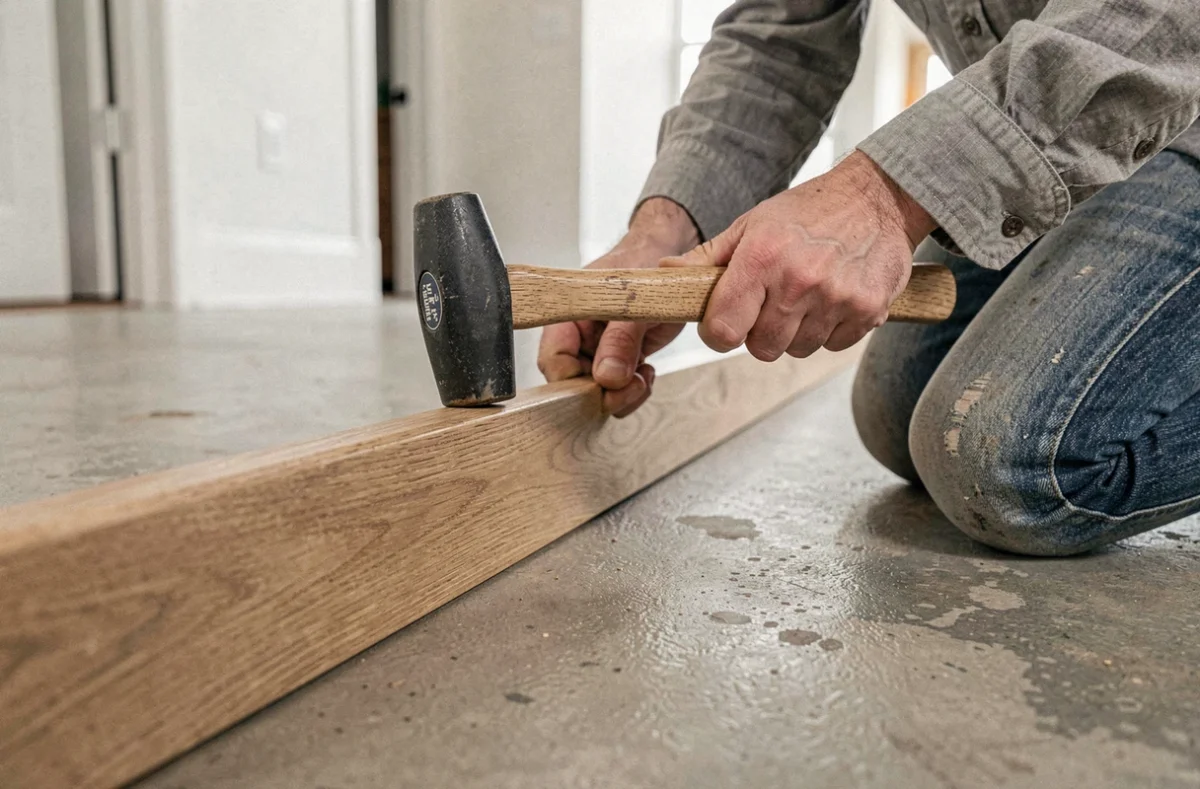
Baseboard materials suitable for polished concrete: comparison by room
The choice of baseboard material primarily depends on the room’s exposure to moisture. A baseboard that works perfectly in a hallway may deteriorate within months in a bathroom.
Dry rooms: living room, bedroom, hallway
In these spaces, MDF, solid wood, or aluminum work without difficulty. Lacquered MDF offers a smooth and discreet finish, often in white, that fades behind the polished concrete. Solid wood adds warmth but creates a marked texture contrast. Aluminum, in a slim profile, extends the industrial aesthetic of concrete.
Wet rooms: bathroom, kitchen, laundry room
A wooden or MDF baseboard is vulnerable to persistent moisture. In a bathroom, MDF swells by capillarity when in contact with stagnant water on the floor. Reliable alternatives are:
- The tiled baseboard with a concrete effect, impervious to water and visually consistent with polished concrete, available in various heights
- The rise of polished concrete itself a few centimeters up the wall, which eliminates the baseboard and creates a watertight connection without visible joints
- The stainless steel or technical PVC profile, fixed to the wall with a flexible joint at the base, which protects the connection while allowing the floor to move freely
The rise of polished concrete as a baseboard remains the most aesthetically homogeneous solution. However, it requires careful application to avoid visible thicknesses at the wall-floor junction.
Height and finish of the baseboard: what changes the appearance of polished concrete
The height of the baseboard radically alters the perception of the room. A low baseboard, a few centimeters high, goes unnoticed and allows the polished concrete to occupy the entire visual space. A high baseboard, over ten centimeters, structures the wall and marks a clear transition between the floor and the wall.
With polished concrete that has a matte or satin surface, a matte-finished baseboard avoids distracting reflections that betray the connection. Glossy or varnished baseboards create a texture mismatch that is difficult to reconcile.
The color also deserves consideration. Three approaches work:
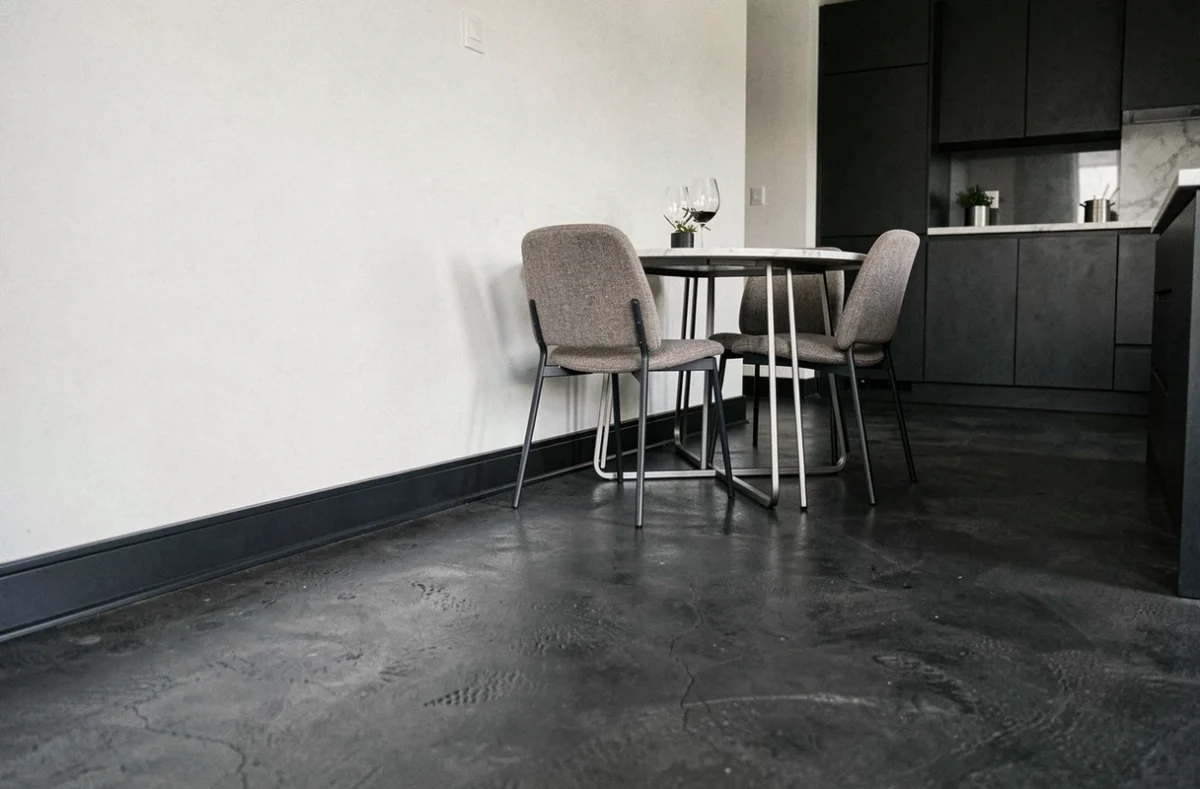
- Baseboard tone-on-tone with the polished concrete (gray, anthracite, beige according to the floor’s shade) for a continuity effect
- Baseboard matching the wall, which visually “erases” the transition and enlarges the room
- Contrasting baseboard (brushed aluminum on dark gray concrete, for example) to assert a decorative stance
Field feedback varies on this point: some installers systematically recommend tone-on-tone, while others prefer to align the baseboard with the wall color. The result depends on the ceiling height, brightness, and the exact shade of the polished concrete, which varies from one applicator to another.
Installing baseboards on polished concrete: the mistakes that crack the coating
The first mistake is installing the baseboards before applying the polished concrete. The micro-coating must slightly rise under the baseboard to ensure the watertightness of the connection. If the baseboard is already in place, the applicator cannot properly treat the wall-floor junction.
The recommended installation order is polished concrete first, baseboards second. This allows for checking the floor’s appearance, adjusting the baseboard height to the millimeter, and placing a clean flexible joint between the base of the baseboard and the surface of the concrete.
The second common trap: using nails or screws that go through the baseboard and penetrate the floor. Any mechanical fastening in the polished concrete creates a stress point that eventually cracks the coating. The fastening must be done exclusively in the wall, either by gluing or by anchoring in the masonry.
The third point of vigilance: the finishing sealant. A standard acrylic sealant yellows and shrinks over time. A flexible polyurethane or neutral silicone joint retains its elasticity and color over time, ensuring a clean connection between the baseboard and the polished concrete even after several years of seasonal expansions.
Polished concrete is unforgiving of approximations at the level of peripheral connections. An impeccable floor can lose all its effect if the baseboard has been installed without considering the movements of the substrate or exposure to moisture. Choosing the right material according to the room, fixing the baseboard to the wall, and respecting the installation order remain the three parameters that determine the durability of the result over time.