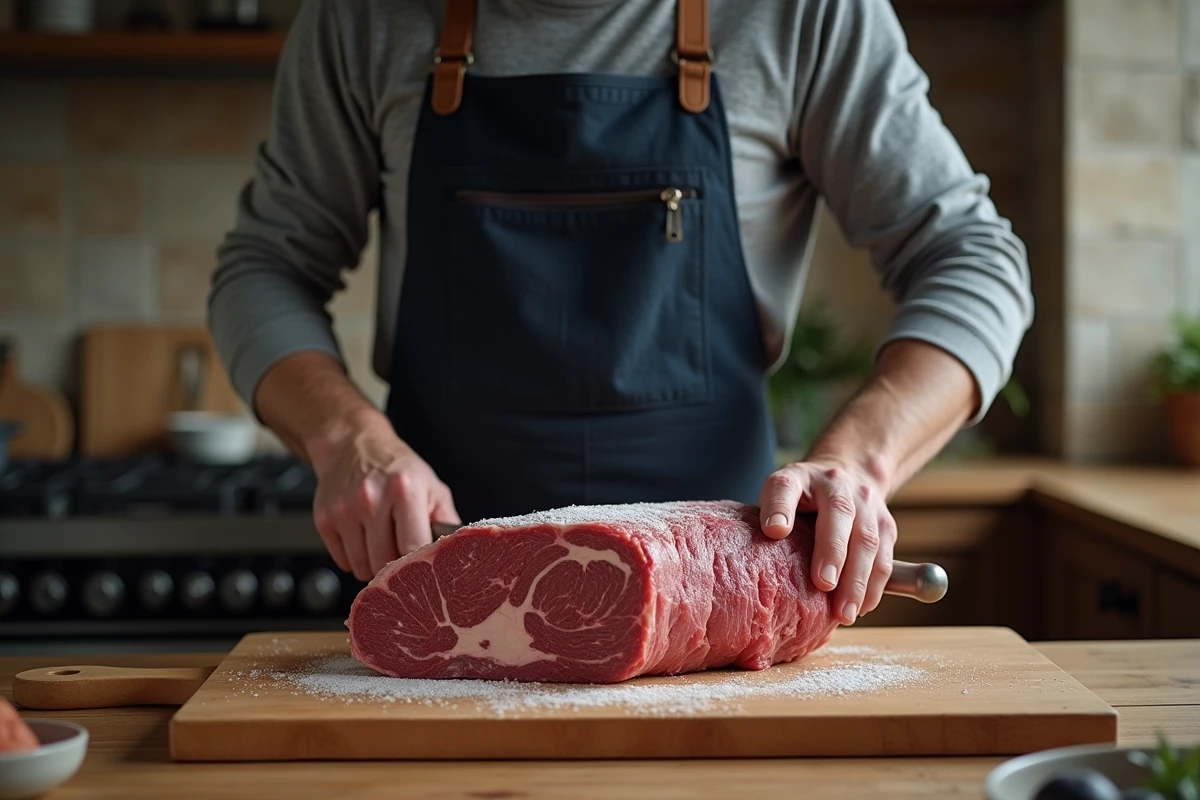
A block of frozen chicken, a pork roast as hard as a brick: have you ever tried to plunge a chef’s knife into that? The blade slips, the wrist strains, and the result oscillates between misshapen pieces and the risk of cuts. Cutting frozen meat requires a different approach because freezing alters the structure of muscle fibers and hardens fats to the point that an ordinary knife becomes almost useless.
What Freezing Changes in Muscle Fiber (and Why Your Knife Stalls)
When the water contained in muscle cells freezes, it forms crystals that stiffen the entire tissue. The meat no longer behaves like a soft food: it reacts like a dense and brittle material. A chef’s knife, designed to slice through soft fibers, loses all effectiveness against this resistance.
The fat also completely solidifies. On a fresh piece, it facilitates the blade’s glide. On a frozen piece, it adds an extra layer of hardness. It is the combination of these two transformations that makes cutting so painful, not just the cold on the surface.
Several techniques for cutting frozen meat exist, but they all rely on one principle: adapting the tool or the temperature of the block instead of forcing it with standard equipment.
Serrated Blade, Electric Knife, or Saw: Which Tool for Which Frozen Block
The usual reflex is to grab the biggest knife available. This is a mistake. The serration of the blade matters more than its size. Here are the three options that actually work, depending on the thickness and hardness of the piece.
- The bread knife (long serrated blade) is suitable for blocks a few centimeters thick. The teeth bite into the frozen surface where a smooth blade would slip. Use a slow back-and-forth motion without excessive pressure.
- The electric knife with blades for frozen products offers a good compromise for thicker pieces, up to about ten centimeters. The oscillating blades do the job without straining the wrist. They can easily be found for a few dozen euros.
- The bone saw (manual or electric) remains the solution for very large blocks, over ten centimeters, like the ten-kilo packages used to feed dogs on a BARF diet. The wide teeth remove ice shavings and prevent the blade from getting stuck.
A neglected point: a thin, replaceable blade often outperforms a heavy large knife. Professional cooking forums regularly recommend reinforced cutter-type blades or interchangeable blade saws because they allow for precise cutting guidance without the brute force that causes slips.
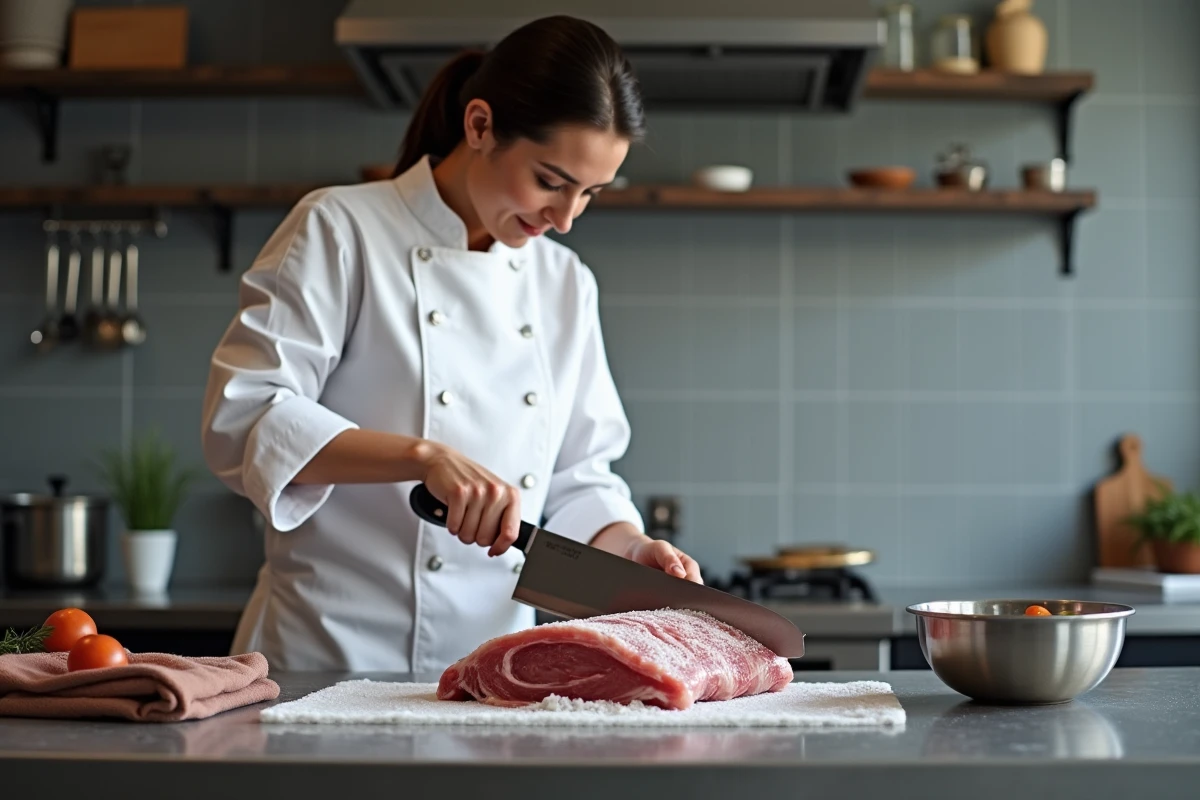
Partial Thawing: The Temperature Window That Makes Everything Easier
You don’t always need to cut a completely frozen block. Letting the meat soften slightly in the refrigerator radically changes the ease of cutting. The goal is not to thaw but to reach an intermediate state where the surface yields under the blade while keeping the center firm enough for clean cuts.
Specifically, take the block out of the freezer and place it in the refrigerator. Depending on the thickness, count between fifteen and forty minutes. The touch guides you: when the surface slightly indents under the pressure of your finger but the inside remains hard, that’s the right moment.
The Trap of Warm Water and the Microwave
Running a block under warm water or using the microwave’s defrost mode creates a peripheral zone that partially cooks while the center remains frozen. The texture of the meat suffers, and the risk of bacterial proliferation increases as soon as the surface exceeds a certain temperature. The refrigerator remains the only reliable method for controlled partial thawing.
Some recent home slicers designed for individuals claim compatibility with partially frozen meat, provided the block does not exceed a few centimeters in thickness. These devices sit between electric knives and professional slicers, and they are an option to consider if you regularly cut frozen portions.
Safety: Avoiding Cutting Accidents with Frozen Products
Hand injuries related to cutting frozen products are a serious concern for home accident prevention organizations. The problem is not the blade itself, but the combination of a slippery surface, excessive force, and unstable handling of the block.
- Stabilize the piece with a damp cloth underneath, or wedge it between two boards if its shape is irregular. Never hold a frozen block with bare hands while cutting.
- Wear a cut-resistant glove on the hand holding the meat. These gloves made of metal mesh or durable fibers are inexpensive and significantly reduce the risk.
- Work on a wide, thick cutting board that doesn’t move. Wood or thick plastic absorbs shocks better than a thin board that slips on the countertop.
- Always cut by pushing the blade outward, away from your body. The sawing motion (horizontal back-and-forth) is safer than vertical pressure that risks slipping.
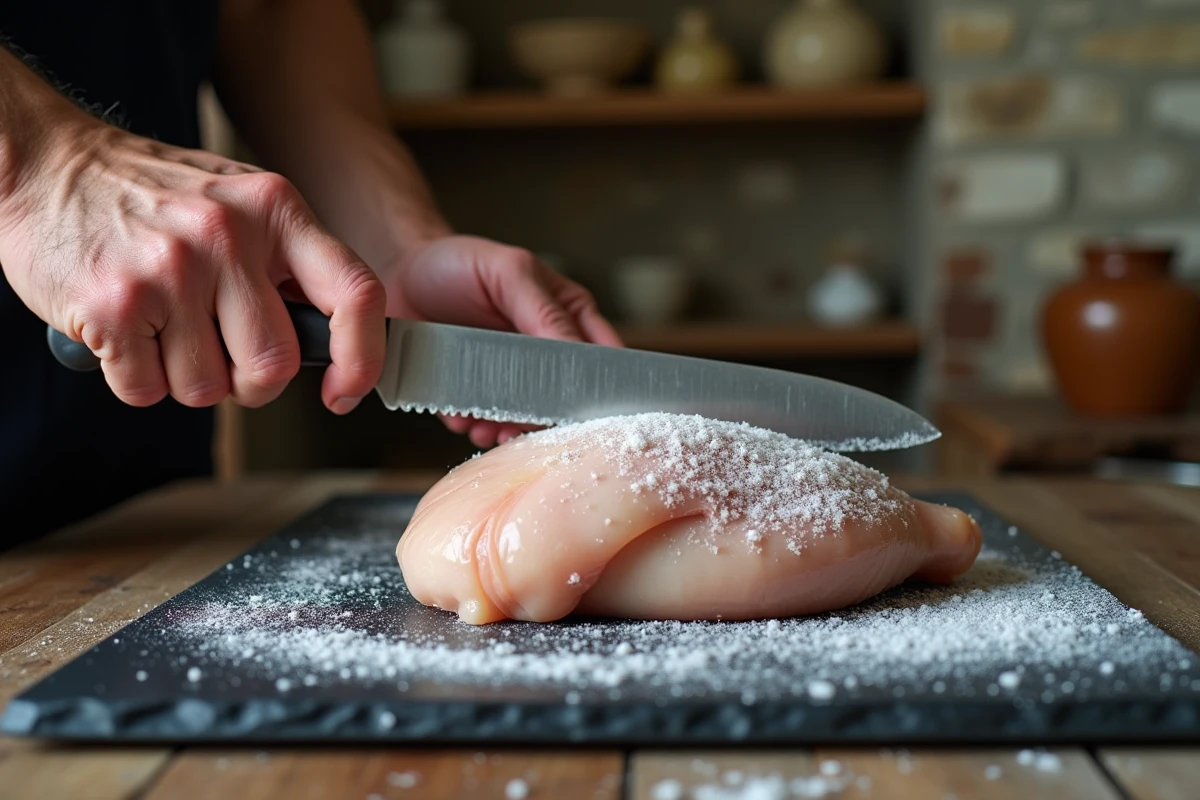
The Case of Large Industrial Packages
Blocks of ten kilos or more, common in animal feed, pose a specific problem: their mass makes them difficult to handle. Several users on specialized forums report having tested DIY tools (angle grinder, chisel) with no convincing success. The most reliable solution remains to request a pre-cut from the supplier before freezing or to repackage the meat into individual portions right after purchase, before placing it in the freezer.
Preparing your portions in advance, separating the pieces with plastic wrap or parchment paper before freezing, eliminates the problem at the source. Portioning before freezing remains the simplest method to never have to saw through a block of meat.