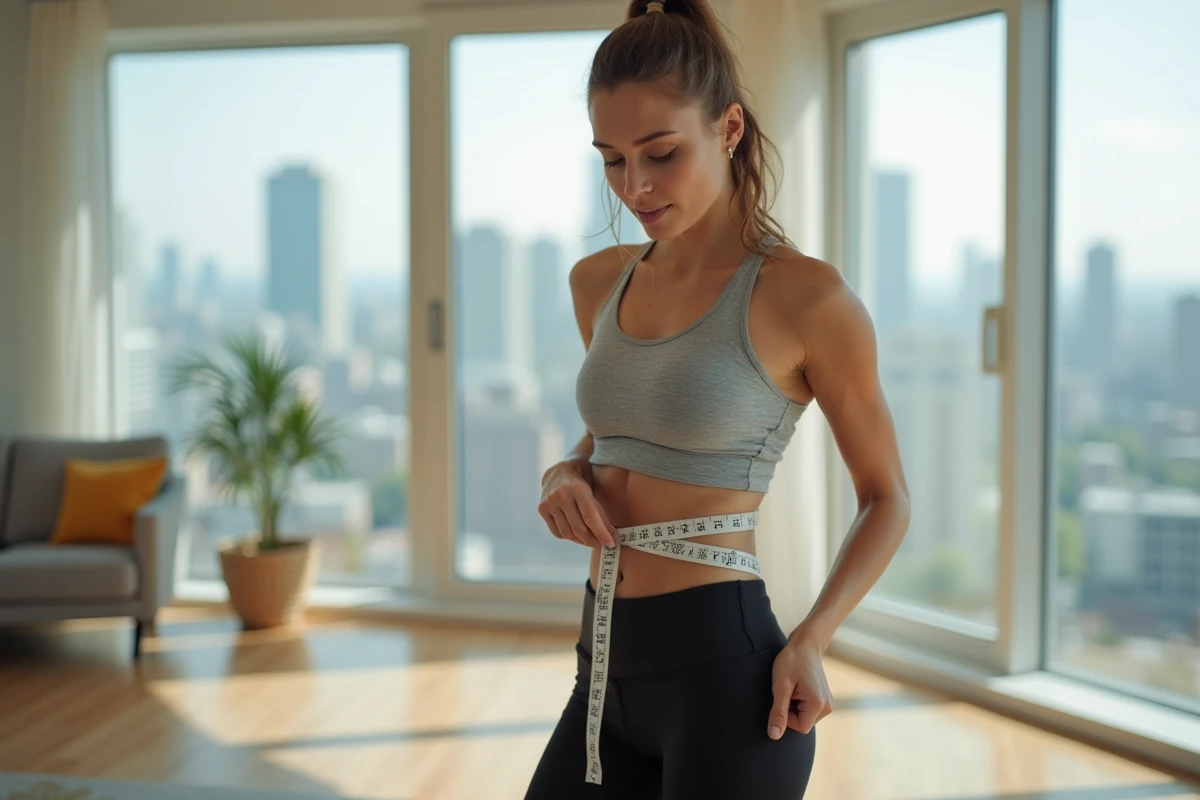
Stepping on a scale says nothing about how the body is composed. Two people with the same weight for the same height can have radically different silhouettes depending on their proportion of muscle and fat. The BMI, used by the World Health Organization since the late 1990s, remains a useful statistical benchmark, but it is not enough to define a toned and balanced silhouette.
Waist-to-Height Ratio: The Number That BMI Doesn’t Provide
Have you ever noticed that some people with a so-called “normal” BMI carry fat primarily around their stomach? This is precisely what the BMI does not capture. The formula weight divided by height squared treats the body as a uniform block. It does not distinguish between subcutaneous fat (that of the hips or thighs) and abdominal fat, which is the most risky for health.
European and Canadian recommendations published after 2020 highlight the waist-to-height ratio (WHtR) as a more reliable indicator of cardiometabolic risk. The principle is simple: measure the waist circumference, then divide it by height in centimeters. A result below 0.5 is generally associated with low risk.
For someone seeking a toned silhouette, this ratio provides concrete information that the BMI ignores. Two people with the same body mass index can have very different levels of abdominal fat, and thus opposing health profiles. Consulting the ideal BMI according to Hub Santé helps understand how this benchmark relates to other more refined measures of body composition.

Ideal Weight Formulas According to Morphology, Gender, and Age
The BMI offers a single reading grid for everyone. In reality, the target weight depends on morphology (slender, average, or stocky), gender, and age. Several alternative formulas exist and deserve to be compared rather than aiming for a single number.
Lorentz, Creff, Monnerot-Dumaine: Three Complementary Approaches
The Lorentz formula incorporates height and gender but not age. The Creff formula adds age and morphology. Monnerot-Dumaine takes bone structure into account through wrist measurement. None is perfect, but their intersection provides a more realistic range than a raw BMI.
- Lorentz is suitable for a quick initial estimate for an average-built adult, male or female
- Creff refines the result by considering aging and morphological type (a slender 50-year-old man does not have the same target weight as a 25-year-old woman with a large frame)
- Monnerot-Dumaine is useful when bone mass is atypical, as it adjusts the calculation by wrist circumference
Comparing at least two formulas gives a more reliable weight goal than a simple BMI between 18.5 and 25. This intersection also helps to put into perspective a result that might seem “out of norm” on a single scale.
Quality Nutrition to Lose Fat Without Losing Muscle
Weight loss does not guarantee a toned silhouette. Losing muscle along with fat results in a lighter body on the scale, but neither more toned nor more defined. The quality of nutrition plays a direct role in this distribution.
Proteins and Synergistic Foods
Recent nutritional publications emphasize specific categories of foods to promote fat loss while preserving muscle mass. Proteins (poultry, fish, legumes, eggs) remain the main lever: they support muscle synthesis even during periods of moderate caloric deficit.
Some foods complement this strategy with their metabolic effects:
- Red fruits provide polyphenols that help regulate body fat
- Nuts (almonds, walnuts) provide quality fatty acids and good satiety
- Legumes (lentils, chickpeas) combine plant proteins and fibers, which slow digestion and limit insulin spikes
The goal is not to follow a strict low-calorie diet. A moderate deficit combined with a protein-rich diet preserves muscle mass and directs the loss towards fat reserves.

Isometric Exercises and Muscle Density: Toning Without Losing Weight
The silhouette is not just about weight. A person can maintain the same weight, keep the same waist size, and yet appear more toned due to better muscle tone. This is the principle of muscle density, which is particularly well developed by isometric exercises.
Why Planking Makes a Difference
Isometric exercises (planks, held planks, wall sits) engage the muscles without joint movement. They strengthen deep fibers, improve posture, and create a visual effect of toning without weight loss on the scale. A more toned belly appears flatter, and better-held shoulders widen the upper silhouette.
For someone whose BMI is already within the range considered normal, this approach is often more relevant than an additional diet. Exercise modifies the ratio between fat mass and muscle mass without necessarily changing the number on the scale.
Combining Cardio and Isometry
Cardio (brisk walking, running, cycling) helps mobilize fats. Isometry sculpts and densifies. Alternating between the two types of effort produces a silhouette that is both lighter and more toned. Frequency matters more than intensity: regular and moderate sessions yield better results on body composition than sporadic intense efforts.
The BMI remains a starting point, not a destination. Measuring waist circumference, comparing several weight formulas according to morphology, focusing on a diet that protects muscle, and incorporating planking into the routine: these four concrete levers shape a toned silhouette much better than a single number on a reference chart.