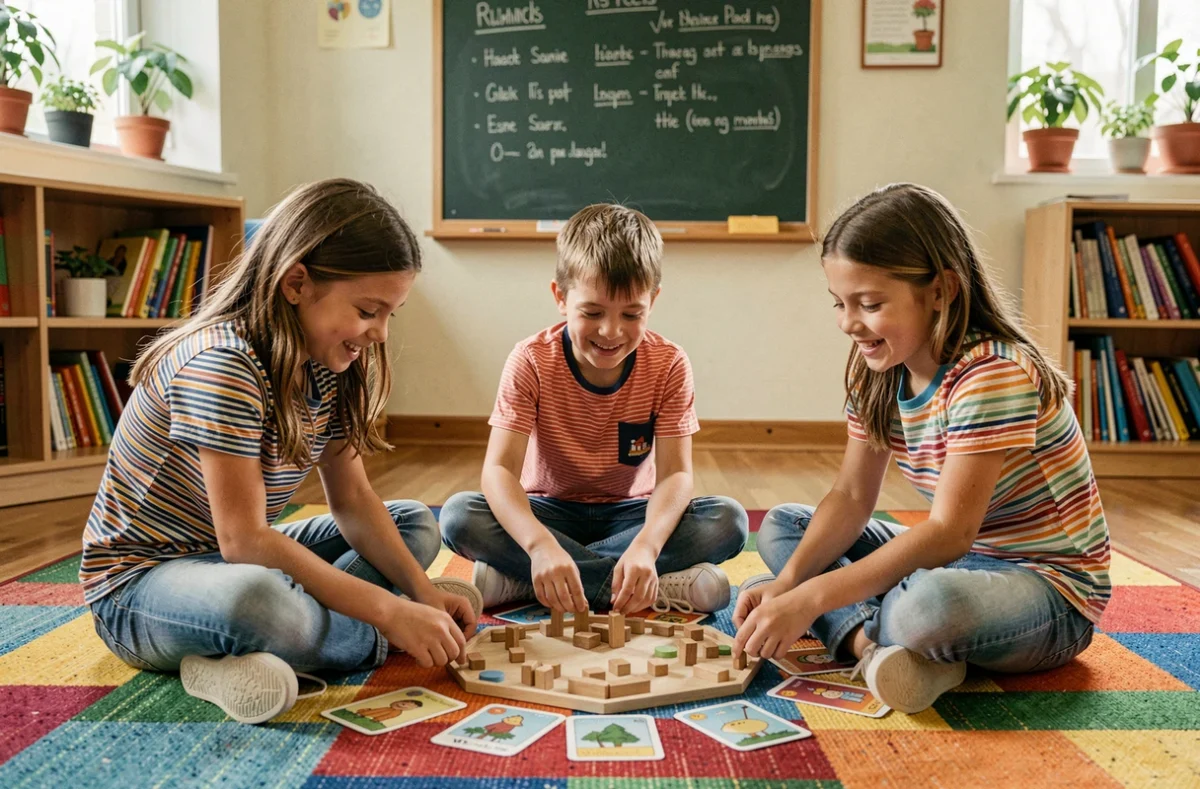
Classroom games are not a recent phenomenon, but their pedagogical use often remains intuitive. A teacher pulls out a deck of cards to review multiplication tables, the students become animated, and the session seems successful. The question is not whether children enjoy the game – that is a given – but whether this approach produces measurable and lasting learning, and under what conditions.
Cognitive Gains from Classroom Games: Beyond Motivation
The most persistent misconception links games with motivation. Students participate more, raise their hands more often, and seem more focused. A recent synthesis on serious games nuances this perspective: the strongest benefits relate to cognitive learning (memory, understanding, application), while the effects on motivation vary greatly from one study to another.
This means that a well-designed game genuinely helps a child retain and reuse a concept. However, the visible enthusiasm during the session does not guarantee what remains in long-term memory. A mental math workshop in the form of a board game can yield better results than a traditional exercise, provided that the learning objective is clear from the outset.
Several resources document this relationship between games and academic outcomes. A file dedicated to learning at school with SDN Rennes details the mechanisms through which a playful activity transforms into a structured pedagogical tool.
Pedagogical Scenario Around Games: What Makes the Difference
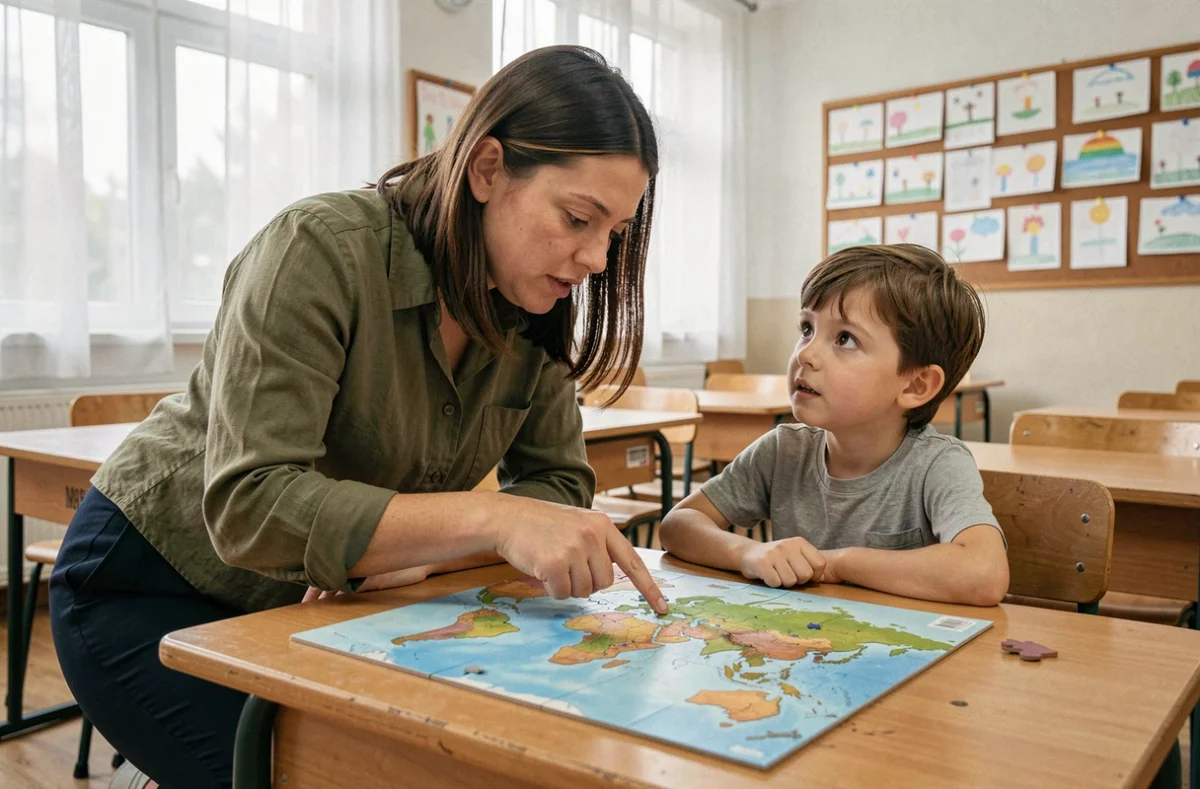
A game placed on a table without a framework does not produce much in terms of academic results. The available data converge on one point: the pedagogical scenario matters more than the game mechanics themselves. A cooperative board game in a science class becomes a learning lever when it is part of a complete sequence.
Components of an Effective Ludopedagogical Sequence
- A learning objective formulated before the game begins, understood by the students. Without this objective, the game remains entertainment without educational grounding.
- Instructions that link the game mechanics to the targeted skill. For example, a role-playing game in history where each player must mobilize specific facts to advance.
- Feedback on mistakes during or just after the game. This time for verbalization allows the child to connect what they did in the game to the concept to be retained.
- A phase of reinvestment outside the playful context, such as a short written exercise or a collective discussion, which checks the transfer of the skill.
Without this structure, the teacher risks noticing a gap between the energy invested in preparing the game and the results obtained in the following assessment. The game alone does not guarantee the transfer to an academic skill.
Digital Games in Class: Opportunities and Blind Spots
Educational applications and digital serious games are multiplying in schools. Tablets in kindergarten, gamified exercises in mathematics, interactive quizzes in cycle 3: the offerings are abundant. Scientific publications on digital gamification in science, technology, engineering, and mathematics have significantly increased in recent years.
Two limitations deserve attention. First, the majority of studies focus on short interventions with limited samples. Long-term effects on learning remain poorly documented. Second, the aspect of protecting children’s personal data is rarely integrated into the choice of tools.
A digital game has a specific advantage: immediate feedback on errors. The student knows in real-time if their answer is correct, which speeds up the feedback loop. However, unlike physical games, it reduces social interactions among peers, an aspect that teachers sometimes compensate for by organizing pair games.
Adapting Games According to Age and Subject Taught
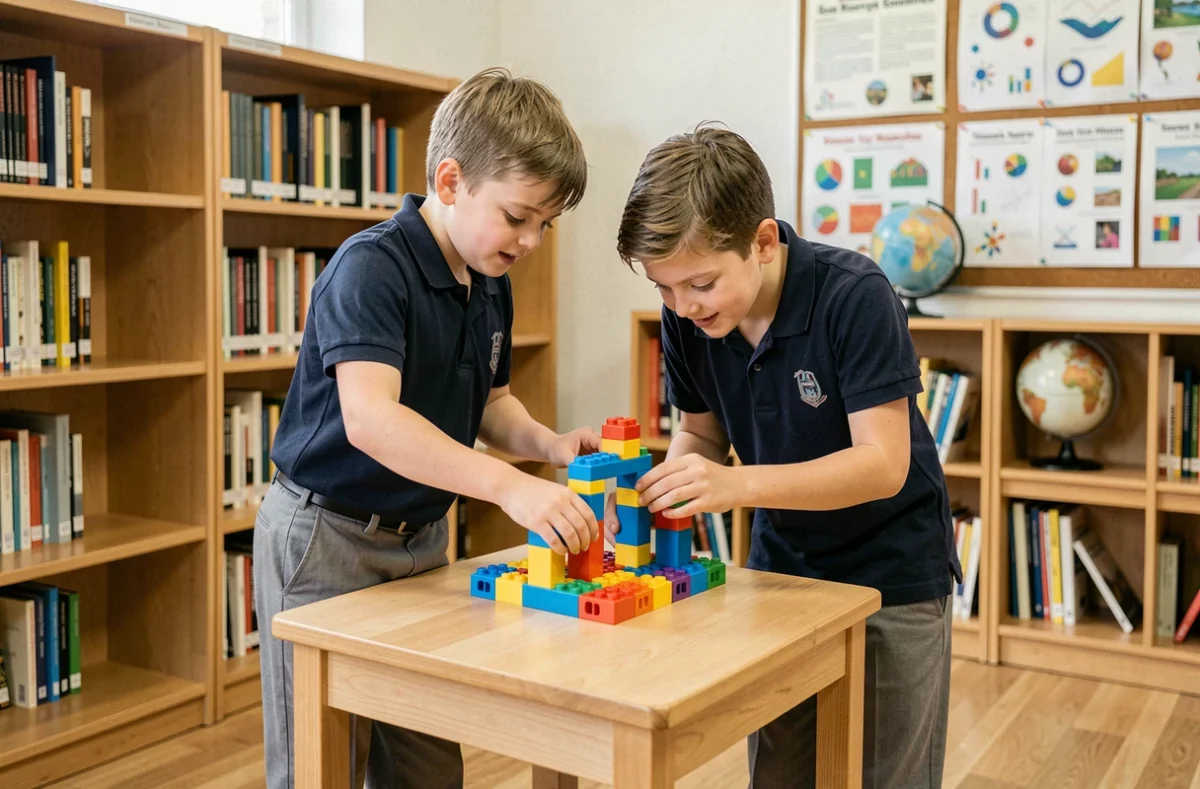
A game that works in a kindergarten class has nothing to do with one suitable for a CM2 class. In kindergarten, free play and symbolic play (kitchen sets, construction, imitation) develop language, fine motor skills, and social skills. The teacher observes, prompts, and asks open questions to enrich vocabulary.
In elementary school, rule-based games take over. Board games for working on numeration, letter games for spelling, cooperative games for problem-solving. The challenge is to align the game mechanics with the disciplinary objective, not to impose a playful disguise on a traditional exercise.
In mathematics, for example, a strategy game that requires anticipating several moves engages logical reasoning more naturally than a worksheet. In French, a guessing game around the lexical field encourages children to mobilize their active vocabulary. The key remains the same: the teacher chooses the game based on the skill, never the other way around.
Known Limitations and Open Questions on Pedagogical Games
Games are not a universal solution. Some students, particularly those with attention difficulties, may be destabilized by the collective excitement of a playful session. Noise, competition, and the speed required by some games sometimes create more stress than learning.
Field feedback also varies on time management. Preparing a quality pedagogical game requires significant investment, and the ratio between preparation time and effective learning time is not always favorable. Experienced teachers in ludopedagogy recommend starting with simple, reusable games over several sessions rather than designing complex setups for one-time use.
The available data do not allow for conclusions about the systematic superiority of games over well-conducted structured teaching. What emerges is that games add a complementary learning modality, particularly useful for consolidation and reinvestment phases. A teacher who alternates structured games and direct instruction covers a broader range of student profiles than a teacher who sticks to a single approach.