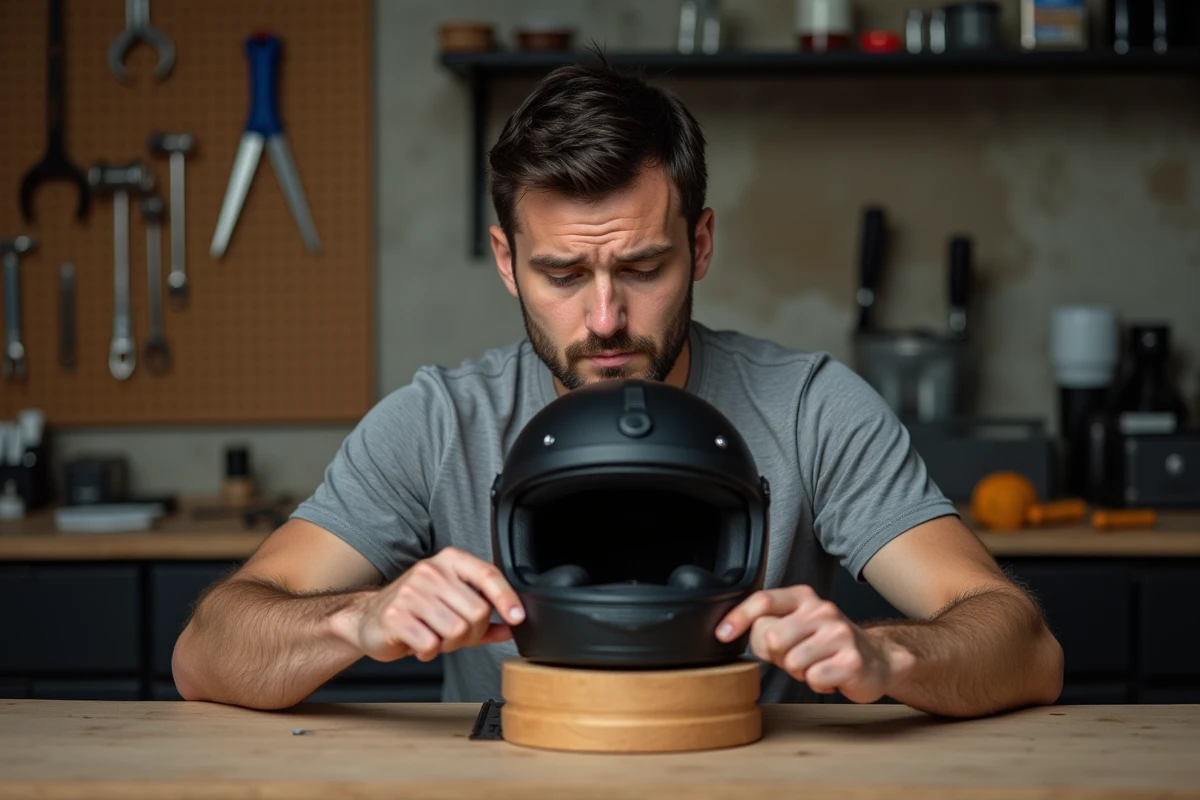
A motorcycle helmet that is too tight causes pain on the forehead, temples, or cheekbones after just a few dozen minutes of riding. The classic reflex is to remove some internal padding to gain space, but this approach quickly hits the limits of safety. Before modifying anything, it’s essential to understand why the helmet is compressing and precisely where.
Head shape and shell shape: the real diagnosis before any modification
A helmet can display the correct size in terms of head circumference while still being painful. The reason lies in the internal morphology of the shell, which varies from one manufacturer to another. Some shells are designed for rounder heads, while others are for more oval or intermediate shapes.
Recent fitting guides, particularly those from Bell Helmets, emphasize this point: morphological compatibility takes precedence over head circumference. A helmet that is too narrow at the temples but correct at the crown is not a size issue but a mismatch between the shape of the head and that of the shell.
Identifying the pressure area allows for the selection of the right solution. Localized discomfort on the cheeks is not treated the same way as frontal or temporal compression. Several options exist to increase the comfort of a helmet that is too small without compromising safety, provided the correct diagnosis is made from the start.

Cheek pads and inner liners: what can be changed without risk
Most mid-range and high-end helmets offer removable cheek pads available in various thicknesses. This is the first adjustment lever and the safest one.
Replacing the cheek pads with a thinner thickness reduces lateral pressure without affecting the protective structure. Manufacturers sell these spare parts specifically to allow for personalized adjustments after purchase.
The liner (the upper padding) can also be swapped out on some models. However, this operation is more delicate: a liner that is too thin alters the helmet’s position on the skull and can degrade vertical support.
Non-invasive external accessories
The trend observed among manufacturers and user feedback leans towards solutions that do not alter the helmet’s structure. Among the most common options:
- Thin fabric caps worn under the helmet, which reduce friction and slightly redistribute pressure on the skull
- Adhesive gel or memory foam pads, positionable on painful contact points without removing any original material
- Soft chin guards and nose covers that modify the chin positioning in the chin bar, reducing pressure on the lower cheeks
These solutions share one advantage: they are reversible. Nothing is removed from the helmet, and nothing is cut.
Thinning impact foams: the red line not to be crossed
There is often confusion between comfort foams and shock-absorbing foams. The former (cheek pads, textile liner) are designed to be replaced. The latter, usually made of expanded polystyrene (EPS), are an integral part of the protection system.
Removing or sanding down EPS foam to gain space nullifies the helmet’s compliance. Bell Helmets reminds us in its guides: a helmet must be adjusted by choosing the correct size and model, not transformed by internal DIY modifications to impact materials.
On specialized forums, some motorcyclists recommend “breaking in” the helmet by leaving it on a balloon or a spherical object. Field feedback varies on this point: natural compression of comfort foams occurs with use, but forcing the process mechanically is not documented by any manufacturer as a validated method.

Too small helmet or poorly fitting helmet: when replacement is necessary
A helmet that causes headaches after less than thirty minutes, leaves deep red marks on the forehead, or prevents normal jaw closure is not “a little tight.” It is unsuitable.
No accessory can correct a real size discrepancy. The solutions described above work for helmets that are slightly too tight or whose shape does not perfectly match the wearer’s morphology. For a true size issue, the only reliable option remains to change the helmet.
Check the fit in three points
Before concluding that a helmet is too small, three checks can confirm the diagnosis:
- Does the helmet move when shaking the head side to side, or does it stay perfectly attached to the skull? A well-fitted helmet does not slide, but it does not compress either.
- Are the cheeks pressed to the point of hindering speech or chewing? A slight pressure is normal with a new helmet, but facial deformation is not.
- Is there continuous pressure on the forehead that causes increasing pain? If the frontal pressure does not decrease after a few minutes of static wear, the shell is likely too narrow for this morphology.
A new helmet should fit snugly without causing pain. Comfort foams compress with use, which frees up a few millimeters over the first weeks. Buying a helmet that is “comfortable from the first try” often means buying a helmet that will be too loose six months later.
The choice of a suitable helmet relies on a prolonged fitting, ideally worn for at least ten minutes in-store. Size/head circumference matching charts provide a starting point, but only trying it on reveals the morphological compatibility between a head and a shell. When discomfort persists despite adjustments, the helmet is not the right one, and no trick will replace a suitable model.